The 14K Token Debt: Architecting System Prompts for Agentic AI
Abstract: In agentic workflows, the system prompt is rarely treated as load-bearing infrastructure. It is often relegated to unstructured boilerplate—a preamble injected before the execution of the actual task. This architectural oversight is the primary failure mode of long-running autonomous systems. Those initial tokens are not a preamble; they are a gravitational anchor. This technical report dissects the mechanics of “Prompt Gravity,” the empirical limits of context retention, and the engineering frameworks required to transition from fragile stochastic instructions to deterministic, compounding behavioral architectures.
A production-grade system prompt typically consumes 14,000 tokens of the context window before the language model generates a single computational output.
Every conversation initializes with this expenditure, paid invisibly during the prefill phase. To contextualize the scale of this structural tax, consider the real compute cost of injecting a 14K-token payload just 100 times per day over a single year across foundation models:
| Foundation Model | Input Cost (per 1M) | Cost per 14K Prompt | Annual Cost (100 runs/day) |
|---|---|---|---|
| Claude 3.5 Sonnet | $3.00 | $0.042 | $1,533 |
| GPT-4o | $2.50 | $0.035 | $1,277 |
| Claude 3 Opus | $15.00 | $0.210 | $7,665 |
| Gemini 1.5 Pro | $1.25 | $0.017 | $638 |
Consequently, developers frequently process these preamble tokens as static overhead—ignoring their structural integrity. This is akin to ignoring your database schema because “the ORM handles it.”
After engineering autonomous systems scaling around frontier models in production environments, a localized architectural axiom has emerged: designing your system prompt is analogous to building your own compiler harness. It forms the base distribution upon which every subsequent vector operation and attention mechanism is conditioned. If the foundational matrix is fragile, the agent pipeline is built on sand.
1. The Entropy Problem (Context Rot)
Without rigorous architectural boundaries, foundation models exhibit a well-documented trajectory in multi-turn environments: they begin executing reasonably, and then they drift.
Each sequential turn compounds context entropy. By turn eight, measurable cognitive degradation sets in. By turn fifteen, the model’s logic has collapsed into the statistical median of its pre-training distribution—producing responses that are syntactically sound, but generically unhelpful for highly specialized domain workflows.
This decay is an architectural certainty, not an empirical anomaly. In their COLM 2024 paper, “Measuring and Controlling Instruction (In)Stability in Language Model Dialogs,” Liang et al. tracked models like LLaMA-2-70B and GPT-3.5, concluding that instruction drift is universally measurable within just eight conversation rounds.
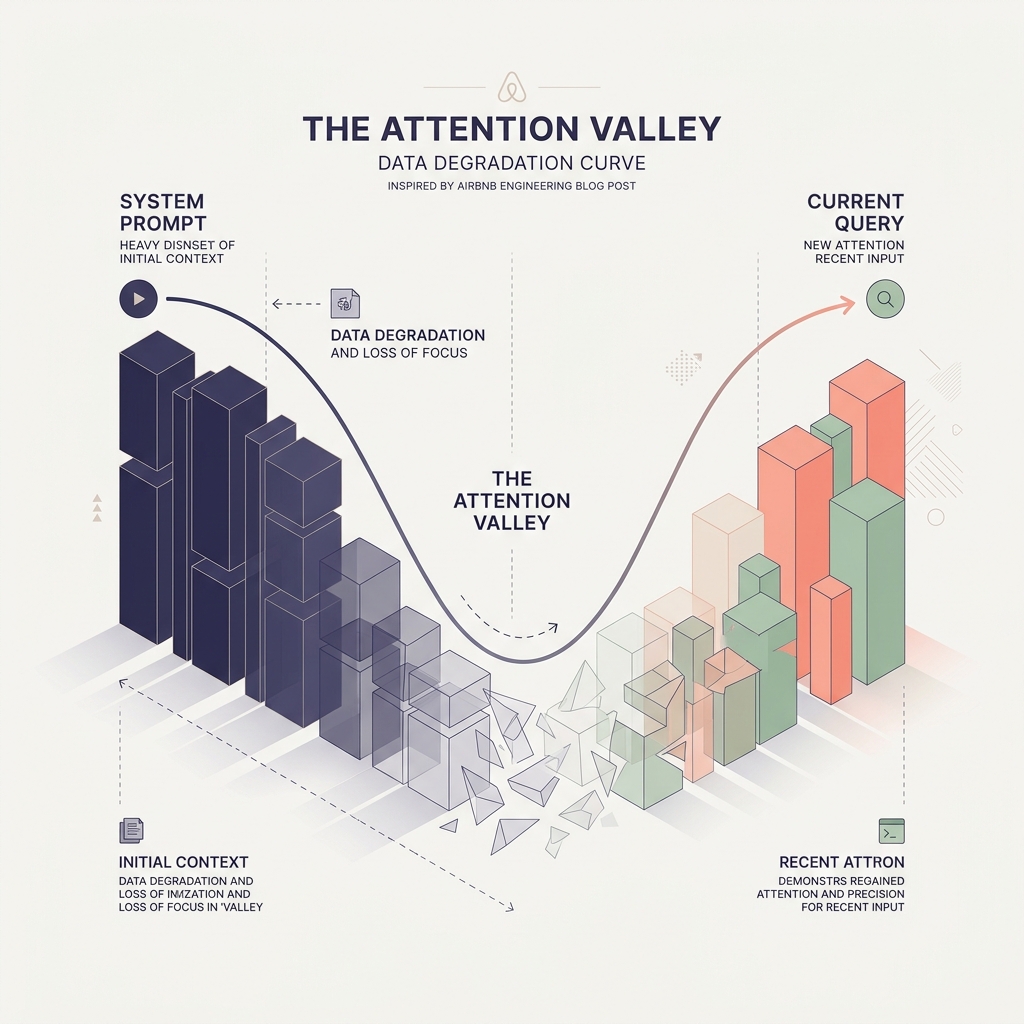
The mechanism resides within the attention layers of the transformer itself. As sequence length expands, the attention matrix disperses across an exponentially growing context matrix. The relative weight allocated to the initial system prompt inevitably shrinks. The directives do not vanish; they structurally dilute.
Visualizing the Attention Valley
This phenomenon maps directly to the findings of Liu et al. in Lost in the Middle (2023). Language models allocate maximal attention toward the extreme peripheries of their context window (the beginning constraints and the most recent user message), creating a pronounced “valley” of forgotten parameters.
Attention Weight Probability [Hypothetical Model]
1.00 │  ██
     │  ███
0.80 │  ████                    << System Prompt Focus (Architecturally Privileged)
     │  █████
0.60 │  ██████                            ███
     │  ███████                          ████
0.40 │  ████████                        █████
     │  █████████                      ██████
0.20 │  ██████████▄▄▄▄▄▄▄▄▄▄▄▄▄▄▄▄▄▄▄▄████████  << "Lost in the Middle"
     │  ██████████████████████████████████████
0.00 └─────────────────────────────────────────
          0K        50K       100K      150K      Current Query
                   Token Sequence Position
Mathematics is unforgiving. At a 100K context sequence anchored by a 14K system prompt, your directives command just 14% of the operational attention bandwidth. At a 200K sequence depth, that structural anchor comprises a mere 7%.
In coding agents specifically, Chroma’s 2025 Study of Context Degradation identified a catastrophic 35-minute operational threshold. Beyond this horizon, degradation accelerates logarithmically, quadrupling pipeline failure rates regardless of the underlying foundation model.
Overcoming Escape Velocity: Prompt Gravity
We define the counter-force to this drift as Prompt Gravity: the mathematical capability of the system prompt to maintain the LLM’s sequence continuations in strict, deterministic orbit around an intended engineering framework.
Without sufficient structural mass—defined tightly by absolute constraints, boundary-case definitions, and hardcode behavioral traces—the autonomous conversation reaches escape velocity, drifting inevitably toward the gravitational center of generic pre-training data.
Those 14,000 upfront tokens are the pipeline’s sole defense against entropy.
2. Abstractions vs. Behavioral Traces
The fundamental liability of standard system prompts—heuristics like “Be concise,” “Enforce strict typing,” or “Think step-by-step”—is that they delegate contextual interpretation to the latent weights.
When you instruct a model to “be concise,” the network interpolates that parameter from its trillion-token training regimen—effectively averaging millions of conflicting linguistic paradigms. Your localized definition of “concise” might strictly require “output only the functional bash script.” The model’s interpretation might yield “a well-structured descriptive paragraph omitting redundant functions.” Only the former allows an automated CI/CD hook to execute successfully.
Behavioral traces resolve this by eliminating semantic abstraction entirely. Engineers must replace fuzzy, adjective-based instructions with serialized, deterministic evidence of what the orchestration layer actually accepted and rejected in prior states.
❌ The Instruction-Based Paradigm (High Variance)
<role>You are a senior infrastructure engineer.</role>
<directives>
  - Be concise.
  - Write robust, production-ready code.
  - Only provide the logical solution without conversational pleasantries.
</directives>
✅ The Behavioral-Trace Paradigm (High Gravity)
<behavioral_trace>
  [HISTORICAL POST-MORTEM - ACCEPTED PATTERN]
  Context: User requested a distributed Redis cache implementation in Python.
  Prior Run Outcome: You generated 180 lines containing redundant abstract classes.
  Orchestrator Action: The orchestration layer rejected all classes.

  [ACCEPTED_STRUCTURE]
  Here is the explicit sub-graph that was merged into production:
  - The core factory dictionary (12 lines, zero inline comments).
  - The raw pytest assertion block (8 lines, table-driven execution).

  [CONSTRAINT]
  When generating decoupled components, force strict conformance to this trace.
  ABORT the generation of abstract classes unless parameterized by user config.
</behavioral_trace>
The delta between these templates is not stylistic; it is the difference between a high-temperature stochastic roll and a deterministic, multi-turn state machine constraint. Meta’s research on semi-formal reasoning confirms this: structured tracking paths elevated code review pass rates from 78% on standard prompts to a rigorous 93% on production patches.
3. The Trifecta of Agent Memory Architecture
To synthesize where behavioral traces persistently reside, agent architectures must be cleanly deconstructed into three isolated functional layers.
| Layer Protocol | Volatility & Scope | Primary Architectural Function | Core Data Primitives |
|---|---|---|---|
| Layer 3: Persistent | Global / Survives Restarts | Accumulating generalized operational experience | Knowledge Graphs, PRD JSONs, Semantic Embeddings |
| Layer 2: Session | Local / Wiped at Termination | Managing finite context for the immediate inference | Tool DAGs, transient file diffs, user transcripts |
| Layer 1: System | Bootstrapped at Initialization | Injecting immutable identity and routing constants | The 14K Token System Payload, Core Skills Matrices |
While monolithic orchestration frameworks expend maximal computational overhead managing Layer 2 (via chunking and RAG context sliding), true frontier architecture relies on a dynamic compilation bridge connecting Layer 3 back to Layer 1.
Instead of treating the system prompt as a static system.txt parameter file, it evolves into a dynamic bootstrapping payload forged by querying persistent memory precisely at the initialization lifecycle. The system layer becomes an evolving organism.
4. Engineering the Truth: Thin Harness, Fat Skills
How is this theory engineered into a deterministic codebase? The optimal design architecture is captured in the “Thin Harness, Fat Skills” paradigm.
A high-performance orchestration harness strictly obeys a three-tier separation of concerns:
- The Harness (Thin CLI Engine): ~200 lines of plumbing. It manages the LLM asynchronous execution loop, orchestrates host I/O permissions, and guarantees deterministic safety boundaries. It possesses zero domain awareness.
- The Deterministic Core: Standard REST APIs, native shell validations, and AST compiler evaluations. LLMs lack native deterministic math functions; offload all binary computations here.
- The Skills (Fat Markdowns Logic): The repository of intelligence. These are massive markdown or text payloads encoding domain heuristics, operational post-mortems, and the behavioral traces detailed above.
The Anti-Pattern: Fat APIs, Thin LLM Context
The architectural inverse involves mapping every conceivable internal capability directly to a strictly validated OpenAPI schema or a rigid Model Context Protocol (MCP) server.
The operational cost of this anti-pattern is devastating: heavy network round-trips for trivial logic paths, massive context windows flooded with unutilized schema metadata, and compounding latency. A UI verification step that natively resolves in 200 milliseconds via direct script injection can easily bloat to 15 seconds through an over-engineered external tool loop.
By hardcoding logic paradigms directly as “Fat Skills” inside markdown files, the model pre-computes the constraints during the initial prefill routing phase, executing complex reasoning frameworks via zero-latency “pseudo-method calls.”
The Autonomous Hook (Implementation Blueprint)
The heart of the Ralph Loop or any autonomous execution is the iterative shell boundary that feeds the context parameters dynamically back into the CLI.
// The Thin Harness: Intercepting the Completion Promise
async function executeAutonomousLoop(prdConfigPath: string) {
  let isTaskResolved = false;
  let exitCode = 0;

  while (!isTaskResolved) {
    const contextPayload = compiler.buildDynamicPrompt(prdConfigPath);

    // Execute the Model
    const actionState = await agent.run({
      systemPrompt: contextPayload,
      cwd: localSandboxPath,
    });

    if (actionState.output.includes("<promise>COMPLETE</promise>")) {
      logger.info("Deterministic completion identified. Breaking loop.");
      isTaskResolved = true;
      exitCode = 0;
    } else {
      // Exit Code 2 triggers reinjection of the failure states into L3 Memory
      logger.error("System exited before completion criteria met. Re-evaluating.");
      await memoryStore.appendFailureTrace(actionState.stderr);
      exitCode = 2; // Hook reinstitutes the loop
    }
  }
  return exitCode;
}
5. Temporal Knowledge Graphs vs Traditional RAG
A traditional vector store operates effectively for documentation retrieval. However, conversational transcripts and operational history are fundamentally different; they map programmable behavior over time.
By indexing complete session artifacts (tool execution DAGs, accepted git diffs, and corrected parameter hallucinations) into a local Temporal Knowledge Graph — using hybrid retrieval tools like QMD — the agent natively queries its own operational baseline before executing the standard inference loop.
This architecture enables three synchronous retrieval vectors:
- Lexical Resolution (BM25): Precise mapping of unhandled exception stack traces.
- Semantic Weighting: Abstract logic mapping (“Where have we managed multi-tenant data migrations securely before?”).
- Hypothetical Document Embeddings (HyDE): Projecting an idealized state topography to resolve a novel code logic conflict.
At the boot phase of Session N+1, the prompt logic inherently questions: “What specific validation pathway succeeded the last time we confronted this distinct edge case?” The underlying transformer parameters remain completely frozen, yet the effective computational yield of the agent improves parabolically.
This establishes a profound mechanism for recursive self-optimization completely insulated within the parameter prompt boundary—circumventing the deep financial and infrastructure liabilities inherent in RLHF or continuous fine-tuning pipelines.
Engineering Trade-Offs & Failure Cascades
Applying intellectual rigor requires identifying systemic fault tolerances inherent in this loop system:
[!WARNING] Context Window Asphyxiation An 800-line harness scaled dynamically via autonomous retrieved history files can exceed 35,000 prefill tokens. Drowning the initial attention distribution with over-prescriptive operational history severely starves the localized attention block required for executing the real-time inference request. Strict token pruning is non-negotiable.
[!CAUTION] Data Rot & Recursive Pollution If an agent continuously appends its own hallucinations to the activity log, and human intervention fails to prune the
guardrails.md, those faulty assertions become encoded as structural precedent. By iterationN+10, the agent begins utilizing its own failure cascades as validated procedural truths. Layer 3 indices require aggressive, database-level garbage collection.
[!NOTE] The Semantic Transferability Cliff A heavily optimized systemic prompt structurally encodes its creator’s explicit biases, blind spots, and architectural preferences. Deploying a hyper-personalized execution harness laterally across varying engineering teams guarantees deep semantic friction. Distinguishing absolute domain skills from idiosyncratic human preferences remains a pivotal challenge in scalable AI operations.
The Compound Architectural Return
The 14K token baseline ceases to represent an operational expense when functioning as a compounding structural investment.
Elevating the aggregate throughput of foundation models revolves around two methodologies: fine-tuning and harness engineering. Fine-tuning forcibly modifies baseline parameters, bearing immense cost, risks of catastrophic context forgetting, and opaque latent dynamics.
Conversely, Harness Engineering fundamentally manipulates the sequence context vector. It is computationally lightweight, totally subject to strict git version control, and inherently deterministic to inspect.
The elite infrastructure teams yielding maximum asymmetric leverage from generative systems are not hoarding proprietary LLM variants. They are deliberately investing the initial 14K token load upfront. They migrated off generic, stateless dialogue APIs into profoundly structured, agentic execution loops (like the Ralph iterations). It is the only guaranteed mechanism to encode judgment directly into the execution fabric.
The harness pipeline should remain completely stripped of logic. The domain parameter skills should be deeply dense. And the Layer 3 temporal persistence graph must perpetually learn.
That is how engineering scales outside the standard training distribution.
Sharad Jain builds agentic AI pipelines in Bengaluru. He previously engineered core data infrastructures at Meta and acts as the founder of autoscreen.ai, a production voice AI platform. He writes deeply about ML systems architectures at sharadja.in.
Research & Footnotes:
- Liang et al., “Measuring and Controlling Instruction (In)Stability in Language Model Dialogs” — COLM 2024
- Liu et al., “Lost in the Middle: How Language Models Use Long Contexts” — Stanford / UC Berkeley 2023
- Anthropic Alignment Science: Building Effective Agents
- Y Combinator (Garry Tan): Thin Harness, Fat Skills Substrate
- Tobi Lütke: QMD — Local hybrid search engine for markdown knowledge bases (BM25 + vector + HyDE)
- Open Source: awesome-claude-code — Ecosystem for structural
CLAUDE.mdmappings.